Michael Cobb’s God Hates Fags: The Rhetoric of Religious Violence – The Work of James Baldwin and His Handling of Homosexuality and its Intersection of Race and Religion

Michael Cobb’s God Hates Fags: The Rhetoric of Religious Violence – The Work of James Baldwin and His Handling of Homosexuality and its Intersection of Race and Religion

Giovanni’s Room is America’s oldest running Gay Bookstore. Although it closed briefly giovannis-roomthis year (2014), it has since reopened, and continues to serve as an outlet for work sensitive to our community. I’ve known about this bookstore since I moved to the Philadelphia area in 2000. Then, I had only a vague idea of the James Baldwin book from which it takes its name.

Baldwin’s seminal piece of gay fiction is an early example an author who showed great bravery in confronting issues relevant to the gay community, especially in an era (the 50s) when doing so was both uncommon and placed the author in a potentially precarious legal situation. This book is just one of the reasons I admire the work of its author James Baldwin.

Given how much of an icon James Baldwin is for our community, Cobb looks deeper into the author’s work—which handles homosexuality as well as issues of race, often together—in order to uncover how Baldwin often uses religious rhetoric to drive his narratives.

I haven’t read Go Tell It on the Mountain in a number of years, so some of Cobb’s points mountainabout this novel are lost on me—as is the case any time a reader is unfamiliar with the subject of an academic article. However, my familiarity with other works by the author show how the same points apply. For this reason, this second chapter was tough to work through. But a number of significant points surface, and they’re worth discussing.

Among the many points to be made, Cobb asserts that Baldwin uses “a religious rhetoric that can make the injury of race communicate the value of queerness” (67). Citing author Wendy Brown, Cobb develops this idea that “minority resistance is often articulated through injury that gives the minority a strong voice and claim through that violence” (57). For racial minorities, this literal violence speaks to what they have endured over the decades of intolerance in this country. For queers, this violence is as much rhetorical as well as physical. The rhetorical perspective is often enhanced through interpretations of the Bible, wherein people refer to a very narrow place in the Bible in order to support how being gay is “wrong.”

Both Giovanni’s Room and Go Tell It on the Mountain serve as evidence for this argument. And if you’re familiar with these works, read this chapter.

But there is more to Baldwin, and as I read this dense chapter, I couldn’t help thinking of another famous work of Baldwin’s that would have also helped support this argument: the essay “The Preservation of Innocence” (published in 1949). This short (ish) essay provides a succinct rebuttal to those who would use the Bible to denounce homosexuality, and since it’s a fantastic read, I’ll talk about it here.

In this essay, one of Baldwin’s primary ways to argue in favor of the acceptance of homosexuality is to debunk the standard argument against us: that we are, apparently, “unnatural.” As in, God created man and woman to live one way (and not just in terms of procreating) and any action that deviates from that way is unnatural, against nature, against God.

Given how often this particular argument is still so often trotted out, it’s startling how obviously Baldwin counters it. He begins by stating living in a “natural state” is “not on the whole a state which is altogether desirable” (594). We cook our food (changing it from its natural state), use toilets (which don’t grow in nature), and have sex in private, unlike animals, who have sex out in the open, in “nature” (594). In fact, he contends (appropriately), we spend “vast amounts of energy” learning to be unnatural, and in so doing, we lose the ability to contend that being natural is the only way to live.

Basically, we’re hypocrites if we believe otherwise. As obvious as this idea is, sometimes it takes a skilled author to point it out. I wish we mentioned this important point more often, as we are forced to continue to convince people not to discriminate against us.
Posted in Michael Cobb's God Hates Fags | Tagged , , , , , , , , | Leave a comment

Michael Cobb’s God Hates Fags: The Rhetoric of Religious Violence – “The Language of National Security: A Queer Theory of Religious Language”: The American Jeremiad

Michael Cobb’s God Hates Fags: The Rhetoric of Religious Violence – “The Language of National Security: A Queer Theory of Religious Language”: The American Jeremiad

Given the subject matter of Cobb’s book (and my interest in it), I didn’t expect a light read. CobbI also didn’t expect just how dense his ideas can be at times. Much of this chapter, and this book, actually, hinges on his use of an important concept, that of a jeremiad.

According to the Merriam-Webster dictionary, a jeremiad is “a prolonged lamentation or complaint; also:  a cautionary or angry harangue.” Wikipedia, which proves useful in understanding these types of concepts, defines the concept a bit more succinctly: “bitterly laments the state of society and its morals in a serious tone of sustained invective, and always contains a prophecy of society’s imminent downfall.” Their definition seems to work well with the dictionary; plus, the entry also notes that the word has Biblical roots: it comes from The Book of Jeremiah and Book of Lamentations. Both definitions provide a good foundation for what I’m about to discuss.

In his book, Cobb returns repeatedly to what he considers the American jeremiad, focusing intently on what mainstream American society complains about and who is often scapegoated to satisfy these complaints. This jeremiad fuels anti-gay rhetoric on several levels.

For Cobb, our Nation is constantly in a power struggle, wherein, as a nation, we always have an enemy, both within and without, and in order to mark our enemies as such, we often use Biblical language to justify this stance. This is done, according to Cobb, because “religious language is thought to be a secure form of langue” (22). By this he means that the language has been tested and its meaning unchallenged. That is why, when someone cites a Bible verse, such as Leviticus 18:22, the meaning is understood without any detailed explanation needed (25). He finds this troubling because—and I agree—the Bible is a “textually unstable document, which must be translated, implied, refined, interpreted, and applied in very ingenious ways all the time” (23). If this is the case, how then can God’s word be “simple and true,” and something that cannot be challenged (23)?

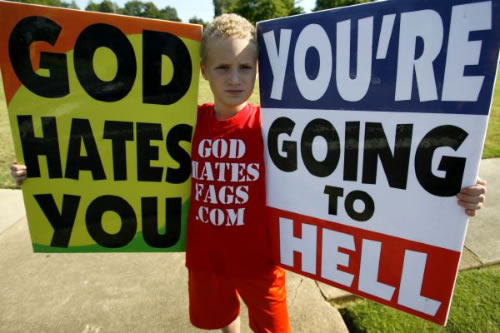
He sees this issue explaining, among other things, the troubling existence of the Westboro Westboro-Baptist-ChurchChurch and their fanatical stance against homosexuality—they (and extreme organizations like them) cite scripture as their defense of their beliefs (and, by extension, actions).

It’s worth mentioning that of all the opposition to gay rights in this country, hate-groups like the Westboro Church are an extreme example, and in no way do they represent the majority of religious organizations that don’t embrace/condone homosexuality. Still, it is worth looking at how any group (or person, for that matter) can rely so easily (i.e. without much of a challenge from the mainstream) on scripture in order to justify anti-homosexual beliefs.

I’ll look more closely and his interesting points on how members of the LGBT community utilize race narratives to explain our existence, as it lends itself better to what Cobb has to say with regard to the work of James Baldwin as well as other writers he discusses in this first chapter.

I will, however, close here with an analogy that wraps up the spirit of his argument. Those in power in our country, especially those in a religious position, who have enjoyed unchallenged power in various facets in society, are losing ground, in part because our society is shifting, with more diversity making up our population. Since most people don’t handle losing power well, they lash out. So here’s an analogy. These people are like children who have grown up as only children, then one day, a new sibling arrives, a human being with whom they must share their space, their toys, their parents’ attention. Some handle this well, some do not. The people in power who are looking for a constant enemy in order to shore up their dwindling power are like the spoiled child unwilling to share. The shame is that if they’ve understood the Bible, they would know that God and Jesus had enough room (and love) for all.

Posted in Michael Cobb's God Hates Fags | Tagged , , , , , | Leave a comment

Michael Cobb’s God Hates Fags: The Rhetoric of Religious Violence

Michael Cobb’s God Hates Fags: The Rhetoric of Religious Violence

When I started this blog project almost two years ago, I hadn’t considered what I would investigate after I finished reading the Bible. To be honest, I didn’t really think I would even continue this project after that. However, books keep finding me, ones that have a point of view to add to the conversation about religion in general and, more specifically, how religion (and thoughts about religion) impacts sexuality (specifically members of the LGBTQ community).

My list of these books keeps growing, and part of how it grows happens as a result of Cobbpeople hearing about this project and recommending titles for me to consider. Every book thus far (I’ve only read a few at this point) presents a different piece of the picture related to the intersection of religion and sexuality. Each has shed light on this issue: why is the Bible (still) used to justify an anti-homosexual stance so often?

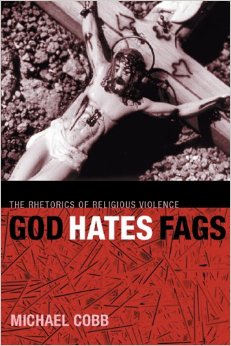
The next book on my desk is the one with the most confrontational title: Michael Cobb’s God Hates Fags: The Rhetoric of Religious Violence.

Rather than promote the thinking behind the hateful expression adopted by the hate-group The Westboro “Church,” this book—as per the introduction—begins with a premise: “What contemporary, anti-homosexual jeremiads* signal, among other things, is that gay, lesbian, bisexual, and trans politics must be concerned with the rhetorical force of religion” (8). Although Cobb examines this point in general, his examination of the topic focuses on how this type of rhetoric belong to “primarily conservative forms of Christianity in the US” (10).

Although I can see why he would believe this—and I do think that the anti-gay agenda is mostly pushed by this slice of Christianity—I am curious to see how he handles the fact that recent ballot measures (like California’s Prop 8) have been passed by a majority not comprised of this group. So clearly their influence extends far beyond their membership.

Most interesting thus far is the way he discusses how, when confronted with this type of hate speech, the gay community often uses a race analogy to “describe our queerness”(15)—positioned as attacked victims, we align ourselves with those who have suffered (and continue to suffer) at the hands of racist beliefs. As he contends, in order to best convey our feelings, we need a “borrowed language of racial injury and violence” (18). Although he understands why we’ve done this, he suggests that this strategy is flawed (for reasons he develops in the book). As someone who has used this analogy in my own discussions and writing, I’m curious how this unfolds—at the moment, I’m rather intrigued about what this can teach me.

The book has four chapters plus a conclusion. Over the course of the next five posts, I’m going to interact with his ideas and pass on how these inform my developing, ever-increasing sense of religion, how it’s used, and how the members of my LGBT community needs to respond. I continue to believe that a small religious minority is twisting what they read and giving a bad reputation to a text that has the potential to offer a lot of good: The Bible.

*If you don’t know what a jeremiad is, neither did I. My next post develops this concept, as it’s crucial to Cobb’s argument

Posted in Michael Cobb's God Hates Fags | Tagged , , , | Leave a comment