A. J. Jacobs’ The Year of Living Biblically: Living the New Testament Literally

A. J. Jacobs’ The Year of Living Biblically: Living the New Testament Literally

The Old Testament may take up far more room in the Bible, but the real meat of the text, indexthe part that ushers in the true spirit of Christianity, is reserved for the New Testament, where Jesus takes center stage. For this content, A. J. Jacobs, in The Year of Living Biblically, reserved the last four months of his experience. During this time, he discovers a lot of interesting points about following the Bible literally.

First, he wrestles with how to handle the difference between moral and ritual laws. The Ten Commandments give us the moral laws: thou shall not kill, etc. Ritual laws, on the other hand, speak to avoiding bacon, not wearing mixed fibers, etc. As he states, Jesus came along and, because society had evolved past the point where the ritual laws made any more sense, he, in Jacobs’ words, “made those laws obsolete” (255).

This distinction is important, for it shows that even Jesus did not adhere to every law in the Old Testament literally. He used his judgment to revise them for the era in which he lived.
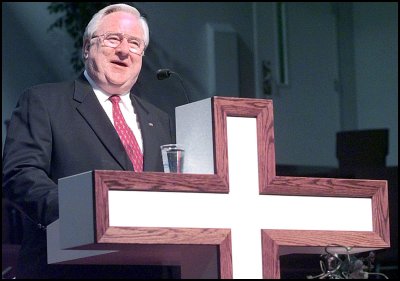
FalwellBut not everyone who follows the Bible seems to pay attention to Jesus’ example. In order to find out why, Jacobs visits one of the titans of the Religious Right, Jerry Falwell. He uses this to experience what Christian Fundamentalist believe, but before he goes, a pastor cautions him: Jesus’ message was one of inclusion, and those followers aim to exclude anyone who does not believe what they believe (258). While visiting the Church in Richmond, Virginia, he encounters a lot of friendly people and even observes that “The radical wing of the Christian right is a lot more boring than its liberal detractors would have you believe” (262).

That said, it didn’t take long to hear about how homosexuality is an abomination.

In this section we get a lot of discussion of this issue. Jacobs even expresses his concern with this sect’s stance on gay people. One person, Tom, agrees, and even says he too has a lot of gay friends—although he means ex-gays, people who have been “cured” (263).

Jacobs balanced this experience with a Bible study group run by evangelical Christians who are all out, currently proud gays. This group embraces their sexuality and their love of scripture with the same fervor (264). Not only does this group demonstrate that a religious person can also be gay and be happy about it, but the group’s leader, Dr. Ralph Blair, says that people need to distinguish between evangelical Christianity and the religious right. As he says, the right’s obsession with homosexuality comes “out of their culture, not out of scripture” (266).

How does Blair support this stance? He says that the Bible is not addressing monogamous, loving same-sex relationships; instead, passages such as Leviticus are anti-abuse and anti-Paganism (266). These passages warn against treating your fellow man disgracefully, something a committed relationship (hopefully) does not. Therefore, as Blair argues, Jesus would have had no problem with a committed relationship of same-sex people (266).

Regardless of what you think the Bible says, Jacob learns a very important lesson in all of this, one that bears learning by all who read the Bible. As the first out Orthodox Rabbi in America Steven Greenberg tells him, people need to “grapple” with the Bible—meaning: don’t take what it says at face value; rather, work with the material to uncover its meaning (268). The entire book is really about “working out the relationship between God and man” (267). This relationship is interactive, and along the way, God has revised his plan for man. For example, in one instance, He uses a flood to wipe out man, but in other places, He shows his willingness to negotiate—with Moses, for instance. Therefore, we should not take anything written in the Bible literally; instead, consider the content as a starting point with which to negotiate our relationship with God or this era’s relationship with Him.

Perhaps part of the problem, as Jacobs learns, is that somewhere along the way, we stopped following what Jesus said and began to follow interpretations of what he said (270-1). People like Paul, for example, who had their own spin on what Jesus said. His ideas clearly present contradictions to what Jesus did and preached in the Gospels.

And if this doesn’t convince people to not take the Bible literally, Jacobs reminds them that even the Bible says not to do this, for people who over-literalize—take things too far, against the Bible’s intentions—are mocked in its pages (290).

But by this experience’s end, Jacobs has not arrived at a place where he is going to chuck everything contained in the Bible. He discusses how this experience he has trained him to follow every rule society enacts, such as seemingly meaningless traffic laws, like jaywalking. And when he did—and you can imagine how funny he looked doing so in Manhattan, where such laws are more or less suggestions—he discovered that what these really added to his life: an “enforced pause” (285). This timeout afforded him moments to reflect, not rush (285), and this, perhaps more than anything, demonstrates that there is value to living by a set of rules, even if they seem ridiculous on the surface.

Although I privileged the gay content in his experience here, I think focusing on it provides an important point: people who use the Bible zero in on a small sliver of the Bible’s content, and when they use it, they are not even representing the spirit of the ideas. Perhaps these people could use one of Jacobs’ pause moments in order to reflect on what they are using and, more importantly, why.

Posted in Jacobs' Year of Living Biblically | Tagged , , , , , , , | Leave a comment

A. J. Jacobs’ The Year of Living Biblically: Addressing the Bible’s “Gay” Content Head-on

A. J. Jacobs’ The Year of Living Biblically: Addressing the Bible’s “Gay” Content Head-on

Leviticus says, “Do not lie with a man as one lies with a woman; that is detestable” (18:22). It also says, “If a man lies with a man as one lies with a woman, both of them have done what is detestable. They must be put to death” (20:13).

In Romans, Paul goes into an extended diatribe about those who worship different gods exhibiting sinful desires that caused them to engage in “sexual impurity,” and thus “abandoned natural relations” with the opposite sex (1:24-27). For these actions, these people “deserve death” (1:32).

How should a Christian follow these words? Or, perhaps a better question is should a Christian follow them?

The Bible has very little to say about homosexuality (it’s found in six primary passages, three of which I quote above)—Jesus never mentions it, unless you make the leap that when he mentions sexual immorality he’s referring specifically to homosexual acts. You would think it were a much bigger deal, given what a massive deal anti-gay people would have you believe through their words and actions. Therefore, I was curious how, or the indexextent to which Jacobs would touch this topic. He does.

In The Year of Living Biblically, Jacobs actually has more to say about what the Bible says about homosexuality than the actual Bible does. I applaud anyone who has no personal stake in an argument but chooses to speak up in favor of those being targeted unfairly. He also covers the topic well.

First, he uses the issue to take a swipe at polygamists. Since the Bible discusses men who have multiple wives, it is only natural that he would seek out people who believe in multiple marriages: it’s right there in the Bible, so it must be endorsed, right? The person he talks to, a Pastor Don, despises the flack polygamists get in modern society. Particularly, he is dismayed that they are jailed “right next to criminals and homosexuals” (138). Apparently, Pastor Don is so far removed from modern society that he doesn’t realize that homosexuals are no longer jailed for being gay, but the point is made. If the Bible says being a polygamist is fine, why isn’t it legal?

Jacobs also, naturally, tackles the viral letter that responds to Dr. Laura’s homophobic rants (202). Famously, this former syndicated personality went on record to say that homosexuality is wrong because the Bible says so. I won’t rehash the fantastic response, but it is worth reading. But Jacobs does reference it effectively in order to point the absurdity of adhering to a sliver of Bible content while ignoring other, more prevalent parts.

Specifically, he explores how often the Bible mentions attending to the fair use of weights Weigh station(in trade, not the gym) –six (230). He applauds the Bible’s mentioning of fair business practices, but, given that it appears as frequently as homosexuality, shouldn’t people be getting worked up about “improperly calibrated weigh stations” (230)?

He then mentions a subject that gets far more attention, Wine-bottles-001racking up 247 mentions in the Bible: alcohol. To dig deep here, he refers to a conservative Christian’s study, which found that of these 247 mentions, 40 are negative, 145 are positive, and the remaining 62 are neutral. Granted, the endorsements outweigh the warnings, but 16 percent of the content suggests alcohol is a problem. I’ll carry his point even further: why aren’t Bible adherents out protesting at liquor stores, holding signs that advocate against alcohol consumption, as the Bible states. People who drink need more help than gays, simply because there are more of them that need saving.

The point to be made by his handling this content: By using the Bible to selectively target gays and lesbians, people are picking and choosing which parts of the Bible to follow. Given how much they clearly choose to ignore—as his experience demonstrates—you could say (I will say), this makes them hypocrites. If not, they wouldn’t stop at protesting, they would follow the Bible to the letter and kill gays and lesbians for their “transgressions.” Obviously we don’t—although ISIS is doing just that right now in the Middle East—and I would never advocate such an absurd and horrendous, intolerant response. We’re evolved, right? We don’t punish people the way people in the Bible did? Why stop the evolution of thought there?

Posted in Jacobs' Year of Living Biblically | Tagged , , , , , , , , , | Leave a comment

A. J. Jacobs’ The Year of Living Biblically: Taking the Old Testament Literally

A. J. Jacobs’ The Year of Living Biblically: Taking the Old Testament Literally

indexBy the time I waded through the Old Testament, I felt, among other things, dirty. I’m not referring to a reaction to the content, per se; rather, the details in those pages make it crystal clear that that era’s ideas of cleanliness were vastly different than ours. This partly explains a number of the laws laid down in Leviticus. So, I was curious to read how a person would replicate those conditions, especially a modern resident of New York City like A. J. Jacobs, as he details in The Year of Living Biblically. Given how violent, dark, dirty as the setting for so much of this part of the Bible is, I was curious how successfully any person could be at trying to follow the Old Testament literally. Especially when the person attempting this is married with a child (as Jacobs is). This part of Bible’s angry God would also be watching closely, right? So no cheating.

In his book, Jacobs details an interesting approach to living by the Bible literally. I had assumed he would follow everything in the Bible from day 1. He doesn’t, and I don’t know that anyone could. But out of his year-long experiment, he reserves the first eight months for the Old Testament. His first order of business: how to keep track of every rule one needs to follow?

Jacobs confronts this first quandary head on: he creates a series of lists that tell him what to follow. As the length of these lists demonstrate, a person is bound to mess up. In order to set himself up for success, then, he cuts himself some slack: he tackles content in the Old Testament in stages. His first list: the Top Five Most Perplexing Rules in the Bible. He picks the one that appears to be the easiest for him to tackle: no wearing garments made of mixed fibers (22). This experience, as with many others, shows how challenging it can be for someone to respect the literal rule of the Bible—he enlists the services of a man who comes to your home and, with the help of a kit (including a magnifying glass), determines the fiber make-up of your clothes.

Is this really serving God? He doesn’t say, but his experience does make a clear case that this is a total pain in the ass, to say the least, and demonstrates that if you are going to follow the Bible literally, you must be committed to these types of inconveniences.

His journey also leads him to experience how other people use the Bible to guide their lives. His journey takes him to Amish country, and this experience yields an interesting story. Sure, he talks to some really nice Amish folks, but the real nugget here is what he understands when he watches an Amish woman work a leaf blower. Turns out, that although electricity is banned, batteries and gas-powered tools are good. From this he draws a useful conclusion: you can’t stop religions from evolving (34). And as so much of the life we experience now—technology, for example—is not accounted for in the Bible, how we use the Bible should evolve with the times as well.

This particular lesson is also useful, in part due to the challenges he faces on his quest. Trying to follow the Bible literally presents a number of practical challenges, in part because a lot of the Bible is not meant to be taken literally. So, in a number of useful places in his story, Jacobs stops to clarify the true meaning of a lot of words and phrases in the Bible (and not just because most of us are dealing with a translation, i.e. an interpretation of an interpretation). For example, even non-Bible readers are familiar with the phrase ‘an eye for an eye’ in the Old Testament. Jacobs states that this should not be read literally because what it actually means is “cash for an eye,” meaning that if you hurt someone’s eye, you need to pay them the “monetary value of the eye” (68). The difference is significant, as should be clear. He covers many such instances in the Bible.

So if so much of the Bible should not be taken at face value, should we bother reading it? He’s advised by several religiously-learned individuals that he needs to “look beyond the weirdness” that permeates a lot of the rules in the Bible and instead try and figure out the spirit of the intent, what it is really saying (87). Handled this way, the Bible seems much more practical that it does on the surface.

But people do this all the time, I imagine some people saying in response. Of course they do, I would say. But these aren’t necessarily the people protesting against gay people. These people are the ones who are using the Bible unjustly. Although this fraction is a minority of Christians, they are the ones with the loudest voice. They are the ones who need to pay closer attention.

But Jacobs isn’t focused on this vocal minority—although he does tackles the supposed anti-gay content, he’s more concerned with following all the rules, and when he does, he discovers something rather interesting: there’s a certain amount of liberty that a person experiences when their freedom of choice is restricted (143). He also discovered that being forced to comply with certain rules added something to his life, not take away. For example, although it’s difficult in the beginning, following the no-working-on-the-Sabbath becomes something he looks forward to (251). He’s forced to relax, and as someone who has trouble unplugging myself, I can see how this would be a rule worth embracing.

Is he a better person in the end? As someone who began this process as an agnostic, he finds that religion grounds him, makes him more present in this world. And the more he stops to notice, the more he appreciates. This is the real payoff.

Having read the Bible myself, I appreciate what this experience did for him. I don’t know that I experienced the same level of awakening that he did; however, about his final point about feeling grounded, I would agree that immersing yourself in the Bible does open your eyes to the world around you in new, beneficial ways. That said, I find that doing so forced me to be hyper aware of my sexuality in ways I was not before: The Bible forces me to think about being gay much more than I would, especially at my age (40), when I’m much more settled in my life (i.e. not out barhopping, clubbing, as I did in my 20s). Being gay is a part of my personality (like being a Star Wars collector or an avid Pearl Jam fan), but it doesn’t define me. The Bible, and those who choose to take the few places The Bible mentions homosexuality, would have it define me. And that’s a problem.

Next up: I examine how Jacobs addresses the gay content in the Bible.

Posted in Jacobs' Year of Living Biblically | Tagged , , , , , , , | Leave a comment