A. J. Jacobs’ The Year of Living Biblically: Should You Follow the Bible Literally?

A. J. Jacobs’ The Year of Living Biblically: Should You Follow the Bible Literally?

When I began this blog project in 2013, I heard of A. J. Jacobs’ The Year of Living Biblically. On the surface, this book’s narrative sounded exactly like my blog: the author spent a year investigating the Bible. The details of his experience are vastly different, however. I wanted to know what was in the Bible, which is so often used to justify homophobia. Jacobs was curious what would happen if a modern person attempted to follow the Bible, literally.

I put off reading his book, in part because I had to read the Bible first. Once my project indexexpanded in order to include what other books could add to my understanding of the Bible, I sought his out. Although I wasn’t exactly sure how, I figured his story would add something to my overall experience. When I received the book, the cover made an impression, one that caused me to question the extent to which I would gain something useful. Dressed in a white robe, a black and red striped covering, and clutching two small stone tables in one hand and a to-go coffee cup in the other, the author looks a bit ridiculous. He also bears more than a passing resemblance to the actor who plays Jonah on Veep, a likeness I could not ignore as I read. So I could tell the read would be entertaining, perhaps even silly, but I wondered how much depth there would be. How much would I actually learn and how serious did he take this experience? Was he taking this seriously?

Then I read the book.

Does his story tear the Bible apart? Not really. He does approach this project with skepticism—how could you not? As a modern resident of New York City, he clearly had his work cut out for him—as even a casual reader of the Bible would understand. For the most part, he succeeds in his mission, although his journey is actually comprised of small victories, not a prolonged adherence to a way of life—the only thing he maintains from start to finish is the growth of his beard, which he never cuts. All the other major rules (and not just the ones in Leviticus) receive focused attention for a number of weeks or a month at a time. But that doesn’t diminish what he learns by doing this. By the story’s end, he’s developed much respect for what the Bible teaches, and in ending the experience, he has an appreciation that transcends day-to-day rules: he has an enlightened perspective on how to be a better person, one who listens first and speaks later; more respectful of strangers, etc.

This is the big take-away from his book: you don’t need to adhere to every point in the Bible in order for it to make you a better person. He’s learned to honor the spirit of what it teaches, and for me that was the most satisfying point in the book.

This month, I will discuss my thoughts on his journey. Beginning with his experience with the Old Testament, I’ll cover how he felt living by these ancient rules, then I’ll discuss how he handles the “anti-gay” content, then his experience with the New Testament. Last, I’ll wrap-up my final thoughts about his book. If anything, I would have liked to find out what his wife thought of all of this, beyond the scattered mention of what she has to say. I was endlessly curious what her experience was being forced to follow the Bible by default—although she may not have followed the rules directly, the fact that her husband did clearly impacted her life. As this was not her project, I wondered how it felt not having a real say (even though she is able to protest a few moves here and there. As a gay man who doesn’t follow the Bible’s rules, I could feel her pain about having it forced on you regardless. Maybe her book is next (if she ever decides to write one).
Posted in Jacobs' Year of Living Biblically | Tagged , , , , | Leave a comment

Reza Aslan’s Zealot: The Life and Times of Jesus of Nazareth – Wrap up and Looking Forward

Reza Aslan’s Zealot: The Life and Times of Jesus of Nazareth – Wrap up and Looking indexForward

The work I encounter for this project continues to fascinate me. It also continues to deepen and expand my understanding and appreciation of the Bible, the world in which its events are situated, and the political climate that dictated how its content would ultimately be shaped.

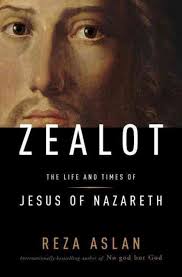
Aslan’s Zealot: The Life and Times of Jesus of Nazareth provides an interesting, informative examination of Jesus as well as a few key players in the early Church. As I mentioned, I had expected a book that investigated Jesus and determined that he was not the man that the Bible portrays. Instead, this book handles these important figures with respect, and in his discussion, Aslan seeks not to destroy but rather to untangle much of the content that the New Testament has skewed. In so doing, he is able to re-contextualize it, which provides a clearer picture of the faith people are following.

Predictably, Aslan doesn’t bother addressing any of the supposed gay content in the Bible. Why would he? Even though the Bible surfaces in mainstream discussions about homosexuality more than any other conversation, Jesus never mentioned homosexuality. But Paul, on the other hand, says a lot about homosexuality—particularly in Romans. And even when discussing him, Aslan never touches homosexuality. Instead, he focuses on what’s important. Do I think that this means Aslan has no opinion on homosexuality? I have no idea, but by focusing on what he does, Aslan by extension asks people to focus on what matters too. Too often, people are focusing on a minute detail by devoting so much energy to homosexuality. This turns the “issue” into something bigger than the Bible does. So why should we?

Furthermore, we should consider the source. As Aslan’s chapter devoted to Paul demonstrates, we should take a moment to think long and hard about the authority to whom we have granted a major say in our society’s thoughts on homosexuality.

To say that the Bible says homosexuality is wrong is accurate. Yes, it’s in there. But if the source within this book was discredited by the very organization/movement he professed to represent, why then are we taking his word for things? We can’t turn back time and interrogate Paul. Why then don’t we bother relying on the people who could? To disregard what they believed over Paul seems problematic, and not just on the gay issue. What else might he be mis-representing? It seems clear that if Jesus actually met Paul—as opposed to supposedly visiting with him in the spirit form—it seems clear that he would have set him straight.

My journey on this blog continues in May, as I discuss a book I found called The Year of Living Biblically, by AJ Jacobs. My sense is that it’s a somewhat humorous take on what happens when a person tries to follow the Bible literally. I don’t know what if anything it will add to this project, but I’m going to read it with an open mind.

Posted in Aslan's Zealot | Tagged , , , , , | 5 Comments

Reza Aslan’s Zealot: The Life and Times of Jesus of Nazareth – A Deeper Look at James

Reza Aslan’s Zealot: The Life and Times of Jesus of Nazareth – A Deeper Look at Jamesindex

Before I read the Bible, I knew that Jesus had a family, including siblings. I think I knew that a few of these siblings were involved in his ministry; the extent to which was unclear, however. Reading the New Testament cleared up some of this. Yet I didn’t realize that his brother James was all that important—certainly not on the level of Paul or Peter. After all, he only gets one sliver of a book to himself. It never occurred to me that this was a problem. I assumed that the Bible included what it includes because the most historically important people were given the bulk of the voice on the page.

But what was James about? As I posted in 2013, about James’ short Epistle, he’s concerned about those who judge:

He states that those who judge actually speak against God’s law and in so doing, they judge the law (4:11). The line here suggests that God doesn’t need anyone’s help in this department, which is why James asks, “who are you to judge your neighbor”?

Then James offers this nugget: “whoever turns a sinner from the error of his way will save him from death and cover over a multitude of sins” (5:20). I appreciate the impulse—the idea seems rooted in caring about your peers—however, something important escapes James here: how can you point out a person’s faults (the error to which he refers) without judging?

Here, I was concerned about those who choose to judge members of the LGBT community and do so with Biblical backing. I did, however, appreciate much of what I read in James, in part because it ran counter to a lot of what I was reading from Paul’s point of view. I was also confused as to why these two voices seemed so far apart. They seemed to be on two different figurative pages.

Aslan’s Zealot explains why.

In the final chapter of his book, Aslan takes a close look at James, and in so doing, he has much to say about how important James was to the early Church and why his role was diminished by history—specifically, those who shaped the New Testament.

So who does Aslan say this man was?

“James the Just” defended the poor, owned nothing, and attacked the rich. This highly respected man was acknowledged as the living link to Jesus, and he never wavered in his support of Jesus’ legacy. In addition, he “excoriated” Paul for heretical, inaccurate teachings (197), and he took it upon himself to correct the message inaccurately being disseminated by Paul. James’ Epistle, according to Aslan, is considered an edited and expanded version of one of his sermons delivered in Jerusalem (204), and he used it to correct all that Paul was saying. James was also considered the leader of the early Church, a position assigned by Jesus over 12 times in the Gospels, according to Aslan (203). In contrast, although Paul is considered more important, only one mention of his leadership appears. Aslan suggests that this sole mention, in Matthew, is controversial, as he and other scholars feel it was inserted on purpose in order to make Paul appear important, in part because the leadership at the time tried to marginalize him for spreading inaccurate information (203).

Yet the New Testament privileges Paul, and by extension his take on Jesus’ ideas. This elevates Paul’s version of what Jesus said, and since he never met the man or heard him say anything, this creates an issue. Apparently, everything he knows about Jesus came to him through the spirit Jesus. So one wonders why Jesus would have changed his tune after his death and resurrection and not bothered to tell the people leading the movement he started.

Turns out other texts paint a grim picture of Paul as well. Aslan includes the work Recognitions (from the middle of the second century), which, when discussing the confrontation between James and Paul in the Jewish Temple, refers to Paul not only as Saul (his name prior to his religious conversion) but also as “the enemy” of the Church (211). This work survives independent of political influence.

In contrast, according to Aslan, James’ leadership role is cemented in Josephus’ Antiquities (from 94 c.e.). This work—which apparently contains the first recorded mention of Jesus—devotes much attention to James’ death, more attention than even to Jesus. From this, Aslan argues that James was Christianity’s leader, and therefore far more important than the New Testament portrays (199-200).

But why was James shut out?

Aslan’s reasoning is interesting: after the Jewish revolt against Rome and subsequent destruction of Jerusalem, the Imperial Christianity taking root abroad (specifically in Rome) needed to sever its ties to Jerusalem and the Israeli traditions that helped create it. Jewish ideas were tainted. Paul’s take on things, therefore, made more sense. These Christians needed a revised version of the belief set in order for it to be its own thing, i.e. non-Jewish.

The more I read about James, the more I respect the man and his dedication to his purpose. He gained nothing from devoting his life to Jesus’ teachings: he was poor, and his beliefs eventually cost him his life. He also appeared to have not altered what Jesus taught just because he could. Knowing what we know now—or what people in the Church allow themselves to know—I wonder why his role has not been revisited and more of his work included in order to influence the Bible’s modern content. I may not agree with all of it, but at least Christianity in general and the Bible specifically would more accurately reflect the teachings of the man who fathered the faith: Jesus. I would like to think the LGBT community would come out ahead if this were the case.

Posted in Aslan's Zealot | Tagged , , , , , , | Leave a comment