The Apocrypha: The Bible Project’s Next Phase

The Apocrypha: The Bible Project’s Next Phase

I never gave much thought to the “completeness” of the Bible. Until I’d read it, I wasn’t even aware of what was in it, much less have a sense of what might have been taken out. I did know enough that King James revised the good book in order to make his (married) life easier, but it never occurred to me that there might have been a lot of material that had been intentionally omitted at some point in history.

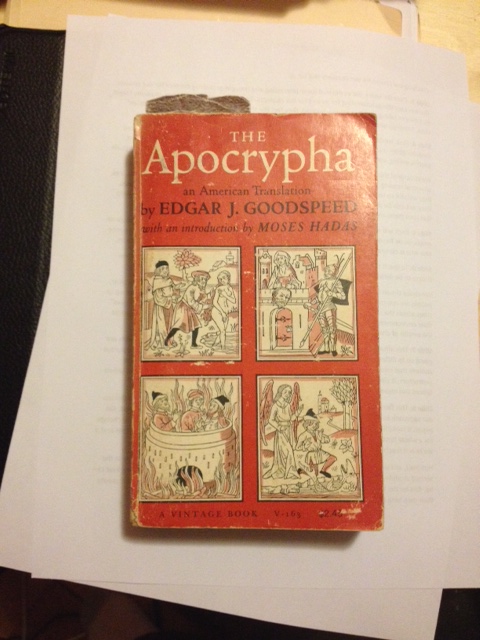
Some of that content is contained in The Apocrypha, which contains books of the Bible that were not canonized. Here’s a succinct synopsis (located on the Amazon page for my version of the book) that explains the content better than I can:

The Apocrypha consists of the books that are found in the Greek version of the Jewish Bible–the Septuagint, the earliest complete version of the Bible we possess–but that were not included in the final, canonical version of the Hebrew Bible.

Among this work are the “stories of Susanna, Tobit, and Judith, and other works of great importance for the history of the Jews in the period between the rebuilding of the Temple and the time of Jesus, and thus for the background of the New Testament.”

I like the idea that I get to read more of the story-type books I enjoyed in the Old Testament.

I am looking forward to reading this book, and in so doing, trying to figure out why this material had been cut. In some way, I feel like I’m discovering something I was not supposed to touch. Perhaps I’m most intrigued by the last line in the book’s synopsis: “they are often as powerful as anything in the canonical Bible.”

If this is true, why have they been left out? I can get my hands on this book so anyone else can as well. But if they’re part of the story, shouldn’t they be respected as such by being included?

The Bible Project continues with my reading of The Apocrypha, translated by Edgar J. Goodspeed.

photo

Posted in The Apocrypha | Tagged , , | Leave a comment

So What’s the Point? What Lasting Impact Does Helms Make on My Understanding of the Gospels?

So What’s the Point?

In the summer of 2004, I dated a guy (whom I will call Chris) for a hot minute. He volunteered with a Christian organization in Camden, and although we were clearly not going to work out, he asked if I wanted to join him on a field trip of sorts he was leading with a summer program of a handful of kids to a photography exhibit being held at a coffee house in Center City. The speaker showed slide after slide of his work documenting the impact the military’s operations in the Middle East post-9/11 were having on the people, showing raw images of the devastation, the impact of our military presence.

There were few “happy” images.

To process the experience, we all gathered back at the Church-affiliated building, and I, along with a few adults who also attended, lead a conversation about what we all saw and heard. Each person spoke, including the kids, who had passionate (and often upsetting) responses.

I mentioned how I couldn’t help being reminded of how relative the truth is, and that just because an image is captured and you’re hearing a person narrate a series of events doesn’t mean that any one person has captured the essence of any one moment. How can you, when events are products of a series of ideas, all packed tight with circumstances often reliant on how a person or organization understood things to be? The images we saw didn’t mean that the US didn’t have a right to be there and engaging in the war we were, just as the endless images of damage didn’t mean every person over there was a blameless victim. There’s a reason the old expression that war is hell exists, but the expression didn’t mean war is necessary either.

When I encounter an emotionally-charged experience—like a talk and exhibit of this kind, I have to remind myself that I need to step back in order to get a handle on the ideas conveyed. Too often, it’s so easy to react immediately. I imagine that when devout believers interact with Helms’ ideas, they are dismissive—any person who suggests that the Bible’s content is not 100% accurate is being disrespectful and speaking from a place of ignorance, and therefore, not worth paying much mind.

As someone who does not count himself among the devout, I don’t know what I really expected to think or understand by the time I reached the end of Helms’ book but I do know that I have more questions now that I did before. I do know that I expected some deep revelations about the people behind the writing of the Gospels but I don’t think I encountered any—or perhaps what counts for a deep revelation for me is different than in the circles of people who are well versed in this area. Still, I’m not sure how this book impacts my thoughts on the Gospels specifically or the Bible in general.

One of my blog readers sent me a note about my choice of investigating Helms. He suggested, among other things, that Helms possesses a bias, in part because he sees the Gospels as works of “fiction.” Having read Helms’ book, I can’t say I agree with that take. True, he does argue that liberties with religious texts have been taken and original ideas inserted. But by labeling something fiction, I think of something completely fabricated; Helms shows how the Gospels have their roots in other religious texts. Given this, I don’t think he feels that the Gospels are fiction—which I would assume to be a dismissive label (in this context).

But what if the gospels are fiction? What if only part of the gospels are fiction?

I remember when the James Frey scandal exploded. His book A Million Little Pieces, labeled and sold as non-fiction, told the story of a man who overcame a lot of adversity—including, but not limited to drug addiction and jail time—and managed to regain solid footing in his life. When the Smoking Gun website blew the whistle on the fabricated content (you can read more about that here: http://goo.gl/E1s7), people were incensed. One of those people was Oprah.

Initially, as she called in her support for the author as he sat for Larry King, she believed that if some of the material was fiction, she didn’t care: to her, the powerful message in the book is what mattered. People turned their life around by reading this book, and to her, this is what was important. (You can read more about that here: http://goo.gl/ttkX2A)

Although she changed her tune when she learned the extent of the fictionalized material, her initial reaction is significant. At the end of the day, if people read the Bible and are better family members, spouses, community members, etc., who cares if some or all of it is fiction? The problem only arises if you legislate (in the broadest sense) using the Bible as justification.

At the end of the day, the truth is relative—it also depends on how you use it. If what you understand to be true makes you a better person, who cares if the information can be “verified”? The problem arises when you use your version of the truth to tell people what they should believe—especially when it conflicts with their version of the truth.

Posted in Helms: Who Wrote the Gospels, John, Luke, Mark, Matthew | Tagged , , , , , | Leave a comment

The Mind of John 2-The Second, Unacknowledged Ghost Writer?

The Mind of John 2-The Second, Unacknowledged Ghost Writer?

My love for Pearl Jam extends beyond their music. Over the years, they have demonstrated deep respect for their fans, often finding ways to make us feel special. One of these ways is the fan club 45 they record each year, dating back to when they started the Ten Club in 1991 These 45s contain previously unreleased material, demos, or live cuts unavailable elsewhere. In 1998, their fan club single did something unexpected: Side A became their biggest selling single ever – “Last Kiss.”

This song has an interesting history. Originally released as a single in 1961 to zero fanfare. Re-recorded (on a different label) in 1963, the song charted, though it hadn’t been played on the radio in quite some time, becoming a song long forgotten by anyone not a fan of Wayne Cochran. Pearl Jam guitarist Mike McCready found a copy of the vintage single in a used record store and brought it to the band. The band took to the song and recorded it for their fans to be released that year for the holiday single. When that single got into the hands of a Philadelphia DJ (the legend goes), he played it on air, and, as they say, the rest is history.

For people who don’t pay attention (or care all that much), they don’t even know it’s someone else’s song, which prevents them from appreciating Pearl Jam’s spin on it.

In his last chapter, Helms argues that the final gospel is, in fact, the product of two authors, with the contributions of the second author (content added at a later date than what the original author put down) running alongside the original content. He feels this changes the goal of the original author’s intent. Helms refers to this second author as John 2, and he contends that much of his inspiration comes from the Beloved Disciple.

To clarify, he believes that John 2 was working from a now lost gospel written by the Beloved Disciple, one based on an “eyewitness of Jesus.” Chapter 21 announces the changes this author made to this now-lost gospel (151).

If indeed this part of the Gospel is a change, what necessitated it? According to Helms, Jesus’ failure to return in the lifetime of first followers was a problem for the author (152). The author saw this as a “threat to faith” (152).

Other changes deal with Jesus’ baptism. For John 1, “rebirth is purely spiritual matter, nothing physical is involved” (155). John 2 disagreed, emphasizing the baptism ritual by inserting “water and… into John 3:5” (155). According to Helms, this emphasized John 2’s love of baptism.

Other notable differences concern the Incarnation—eating Jesus’ flesh (158). John 1 believed that “flesh is no avail” (John 6:63) but John 2 rewrote to insist that “word became flesh” (158) and that only the one who eats his flesh will possess eternal life. I can see how having these two conflicting ideas could confuse the reader (or believer).

But there’s more: John 2 restores Peter to the center of attention—undoing the work John 1 created by elevating the nameless Beloved Disciple (159).

So how often have other readers noticed these differences in the Gospel of John and do Helms’ points impact their understanding of this final gospel? I have no idea, but I can perhaps speculate that since the gospel comes around in the end to ideas that appear more in the standard comfort zone, the earlier seeming contradictions matter little. But, again, I could—and probably am—wrong.

In processing this last chapter, I think of Pearl Jam’s cover of “Last Kiss.” If you listen closely, you can pick out the original song structure—as written—and if you know the band well, you can also hear their little flourishes here and there in the guitar work, the vocalizing. I doubt casual listeners could though. I also doubt they care. Most don’t even realize it’s not their song to begin with, and this absence of knowledge doesn’t change their enjoyment—or whatever they get out of the song—one iota.

Posted in Helms: Who Wrote the Gospels, John | Tagged , , , | Leave a comment