Who Wrote Luke (and Acts), and Why Did She Do It?

Who Wrote Luke (and Acts), and Why Did She Do It?

What constitutes controversial has become rather watered down—or at least far more common than the concept warrants. This is especially true when a TV episode or a performance is hyped as being controversial before it ever airs. The sex scene in the season finale of Looking, for example. So, when someone announces something as “controversial,” I’m leery. When this feeling remains—or even turns to indifference after interacting with this controversial item—I like to ask myself if I’m too jaded to find what’s controversial or I’ve reached a point—along with many others in society—where what was once a big deal no longer matters.

For Helms, the controversial argument he makes in his book is that a woman, in fact, wrote the Gospel of Luke. I can see why a great number of religious people in power would find this troubling (and, from their point of view, sadly unbelievable), but I rolled my eyes at this supposed controversy—if anything, you’d think this would be a relief. But before I walk further down that path, first, here’s what he has to say about this Gospel.

Women were not supposed to have a say in Christianity, so how—or even why??—would a woman write this? Well, According to Helms, it seems obvious that this suggests that the female role in the creation and the running of the early church might just be a little different than many people think.

So here’s his case: First, in Luke, only males fail to understand the point of the resurrection and Parousia (61). Women, on the other hand, are the first to believe (Luke 24:9, 11). He also isolates the “curious emphasis on female followers of Jesus” (62) with examples—Luke 8:2-3. Why is this significant? This passage is not echoed in any of the other gospels; therefore, Luke’s author must have wanted to stress its importance. From this, Helms gathered that Luke alone suggests that more women than men were in Jesus’ inner circle and Luke alone places these female disciples at Jesus’ death and resurrection pronouncement (Helms 63; Luke 24:7-8).

Similar emphasis is placed on the content in Acts (which I had no idea was/is seen as extension of Luke, apparently), which contains preaching by both men and women (Acts 2:17-18).

In general, he sees an overwhelming interest in the role of women (63), something he believes would only come from a woman’s point of view—and given how neglected women are in both the Old and New Testament, this makes sense.

He outlines several interesting points on page 65: imimg007g007
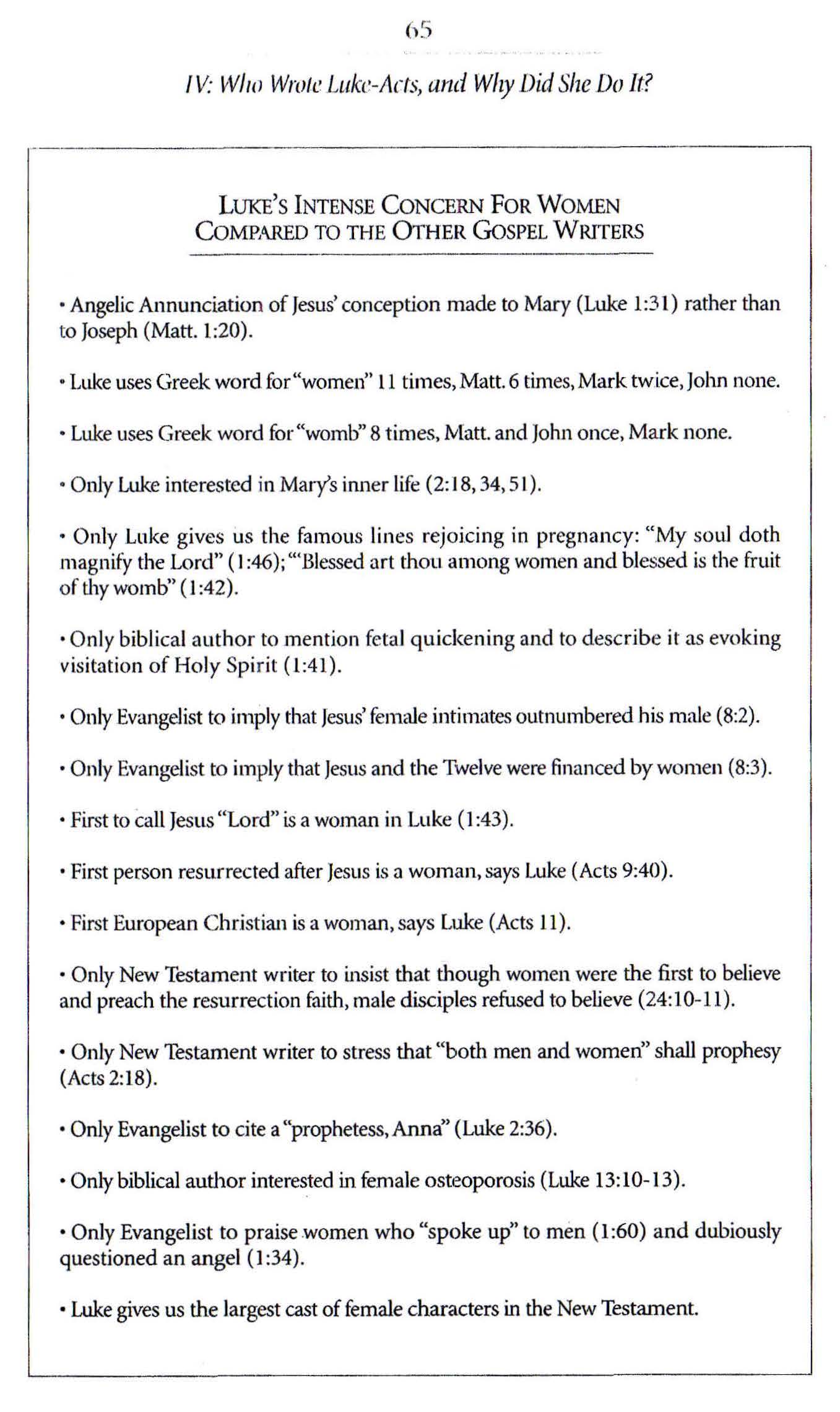
So what does he base this impression on going forward? First, he sees a strong concern for maternal emotion, especially for mothers who have lost a child (67). (I guess men didn’t care?) He also sees women prophesizing (Luke 12:37) and several men and women pairs (70). Apparently, men would not think to mention the women? But perhaps their presence was merely understood?

But there’s more than just these last few seemingly trivial surface elements. Women who speak up are rewarded (72) and wives were just as important (Acts 5:10). Women were even deacons (Helms 75; Romans 16:1). Mary was also a disciple (Helms 75; Acts 16:15), though this is not the Mary.

To cement his case that Luke’s female author had to write this Gospel, he mentions a (seemingly random) example of the hostility towards women in this era: “Good thing for men to have nothing to do with women” (1 Cor. 7:1) (76). Out of all the seemingly (and explicitly) misogynistic content in the Old and New Testament, why pick this line? Does Helms think this isn’t clear at various points?

Still, I did appreciate how much evidence from outside the gospels that he mentions. If you’re going to build a case that women had a stronger say in the Church than much discussion allows for, it does help to pull evidence from throughout the Bible. Although I don’t know that this can support that a woman wrote Luke, I do find the idea intriguing. I think it’s certainly possible. But because I was raised to view men and women equally, I don’t find this as controversial as some would (or do).

Posted in Helms: Who Wrote the Gospels, Luke | Tagged , , | 2 Comments

Who Wrote Matthew? Helms Investigates How Matthew Re-Wrote Mark

Who Wrote Matthew?

When I teach research, I stress how important the quality of sources is. Today’s students have grown up with no (or little) knowledge of what life was like before the Internet, so they’ve always grown up with information at their fingertips. One of the most popular sites for them is, of course, Wikipedia.

Don’t ever use this as a source for one of your papers, I tell them; it’s a great tool, but a bad source. A few students roll their eyes (yes, we know), many look upset, for it had been fine in the past (i.e. high school)—or so they believe, and some appear angry: what do you mean?

And so I share this story: a few years ago—more like 6 at this point—when I taught a pop culture-themed composition course, students had to research pop culture figures—there’s more to the assignment, but I leave it at this. Anyway, several chose Michael Jackson for one of their people. One of those papers contained a chestnut of information about how charitable Mr. Jackson was. The evidence: After Hurricane Katrina, in order to raise money for those affected by the devastation, he wrote and recorded “We Are the World.”—cited with a Wikipedia entry.

This, ladies and gentlemen, is why we need to verify our sources.

As Helms points out, Mark didn’t do a very good job checking his sources—though how one would have went about this back then, I have no idea. So if Mark used flawed sources, Matthew, however, saw an opportunity, for he clearly recognized the need for much of Mark’s content. It just needed to be fixed first.

To clarify the amount of barriers between Matthew’s author and the information he discusses, Helms mentions the “levels of remove from the historical Jesus”:

  1. Personal associates of Jesus
  2. Christian oral traditions about Jesus
  3. Written documents based on oral traditions
  4. Mark
  5. Matthew. (42)

Why mention this? Well, the idea is that how close can a person—any person—come to the truth from this much distance? He’s not making this point (although how could he not be?); rather, he’s suggesting that Mark and Matthew—representing the fourth and fifth removes—are just as relevant.

Aside from fixing key details related to Jesus’ baptism story, Matthew fixes Mark’s confusion over how the parables were intended to be used: they elucidate Jesus’ meaning, not obscure it (48). This change makes sense, for why would a teacher purposefully convey his ideas in a way that confused his audience (students)?

Matthew also has a different impression of Jesus: he’s angrier. This first surfaces in his return to Nazareth. Since Jesus was not acknowledged or welcomed with open arms, he refuses to help out a neighbor (ease his suffering). In Matthew’s eyes, “he is a much less likeable figure” (50). Perhaps portraying Jesus as a benevolent figure to whom you can say or do anything and still receive his love made him too soft for Matthew? After all, shouldn’t we have some fear of our rulers?

And then there is the description of the fig trees. When Jesus leaves Nazareth and is hungry, he comes upon the fig tree, which in Mark bore no fruit because it was not in season. Matthew, however, drops the “not the season for figs,” which, according to Helms places the blame of the lack of fruit on the tree, not Mother Nature (51). So when Jesus immediately punishes the tree by making it wither (not the one-day delay in Mark), this shows he not only has more power than described in Mark, he’s also a bit spiteful.

One of the last significant changes involves the apocalyptic foretelling, covered in Matthew’s 24th chapter and Mark’s 13th. Mark’s turned out to be incorrect, and since Matthew wrote later than Mark, he has the ability to correct the mistake in the name of theological accuracy. Basically, he increased the amount of time between the destruction of Jerusalem and Jesus’ second coming (56).

So why these changes, and what makes Matthew “right” over Mark? I guess if you are a reader looking for more theological “accuracy,” than Matthew is tighter than Mark. Helms doesn’t state this claim explicitly, though all his evidence makes this clear. But given that now we have information neither author had access to—such as the time of the Second Coming (tick tock, tick tock)—how can we see either as accurate? And if Matthew corrected flaws in Mark, he was still working with a flawed source, so although he corrected mistakes he understood to be inaccurate, what about the errors he (or we) didn’t know about? A flawed source is a flawed source, even if he had the best intentions.

Posted in Helms: Who Wrote the Gospels, Matthew | Tagged , , | Leave a comment

Who Wrote Mark, part II – Helms Focuses on Mark’s “Apocalyptic Mind”

Who Wrote Mark, part II

Words matter, in part because of their purpose: when selected carefully, they convey what we mean with precision. They can also mask our meaning—or at least cushion your meaning. Why would one would do this varies, of course.

For example, how do you define “crazy”? According to Google: “mentally deranged, esp. as manifested in a wild or aggressive way.” This matches my definition, and I never thought of a different way to understand this concept. That is until someone pointed out to me that crazy is usually only reserved for poor people. Middle-class people get to be “neurotic,” whose synonym is “mentally ill.” Rich, upper-class people get to be “eccentric.” The synonyms for this fun word carry a significantly less negative connotation, such as aberrant or simply odd. But the odder a person acts, the more eccentric a person appears: i.e., crazy.

I’ve always wondered: if you mean crazy, call it crazy. But, of course, if you call a person crazy, aren’t you compelled to do something about it, such as get that person help?

I had this idea in my mind as I began Helms’ second chapter devoted to Mark. First, I wondered why his ideas—which, to be honest, could have been covered just as well in the previous chapter—needed a second pass. Second, I wondered why his main argument in this chapter—that Mark’s author suffered from an “apocalyptic” point of view, which, as Helms points out, means he’s delusional (i.e., crazy)—doesn’t come right out and label Mark’s author crazy.

If you think someone’s crazy, that means they’re not worth listening to, right? Helms avoids this explicit argument, choosing instead to support just how apocalyptically minded Mark’s author was. In fact, Helms sees Mark’s author as an ancient Debbie Downer, a person who was utterly convinced that the end was near. This mindset affected how Mark worked with his main source—The Book of Daniel, which, according to Helms, is also the product of an apocalyptic mind, and even one littered with errors.

The first error Helms identifies is the supposed era in which that book was written: not the 6th century BCE, but more like the 2nd century. How does Helms support this? Daniel’s handling of the events mentioned concerning 6th Century BC are inaccurate (20-21). For example, in the opening of Daniel, the author declares “In the third year of the reign of Jehoiakim king of Judah, Nebuchadnezzar king of Babylon came to Jerusalem and laid siege to it.” According to Helms, the siege happened in the first year of Jehoiachin, Jehoiakim’s successor. Chapter 5 mentions a Darius the Mede who took the kingdom of Babylon. Helms points out that no such person existed; Cyrus the Persian conquered Babylon (21).

Due to these details (and many others he mentions), Helms calls Daniel “vague and inaccurate” (20); its handling of information about the second century BCE is right on point, however (20). From this, Helms concludes that Daniel was actually written then, not in the sixth century (as that book claims). So can and should you trust a text that lies to you right off the bat? And if you believe the person handling these details is so delusional, why bother making this case in the first place?

One reason: Mark is not the only person to reinterpret Daniel. First Maccabees did as well, which suggests that delusional issue was overlooked often. This is important, for as Helms deepens his point about being delusional, he mentions that these people possess a skewed view of the world (that the end is approaching) and that all but he and his peer group will perish (23). This is why Helms believes that Mark reinterpreted Daniel’s false apocalyptic prophecy: the time predicted by Daniel came and went, he needs to adjust when Jesus will return (24). Mark could have noticed the mistake in Daniel, and instead of leaving it alone, he felt compelled to update it-his apocalyptic mind would not let him accept that maybe the end of the world is, in fact, not happening.

It’s a bit strange for someone to take issue with this mindset, given how often these type of ideas surface in the Bible—I imagine he then has similar issues with Revelations, for example. But perhaps it’s important for Helms to emphasize this point in order to distance his beliefs from the ones that perhaps weaken Christianity by coming across as unsound. Since he doesn’t outright denounce Mark for being crafted by a delusional mind, he must see something positive elsewhere in this Gospel.

So what’s Helms’ final impression of Mark? Basically, he sees it as a sloppy draft in places due to its weak source selection. And rather than assert what we should really do with the solid case he makes about the Gospel of Mark, he preps the reader for his discussions of Matthew, Luke, and John, which he sees as responses to Mark.

So I don’t think this information changes my impression of any part of the Bible—to me it is just interesting, like looking at a film that fails on several technical levels, and although this likely would cause me to not perceive such a film as “good,” that doesn’t mean I don’t applaud the effort or at least get some enjoyment out of it, flaws and all. I appreciate the parts that would inspire a person to be a better individual without worrying about how much of what is written is “true.”

Although people like Helms choose to pick apart Mark, perhaps it’s more interesting to consider that Mark lacked the luxury of time or enough feedback to produce something more “accurate.” Was he really delusional—as we know it—or so inspired by his faith that he couldn’t understand his world any other way? Is there a difference?

Next up: Who Wrote Matthew?

Posted in Helms: Who Wrote the Gospels, Mark | Tagged , , , , | Leave a comment